
When people first hear about ketamine therapy, one concern rises above the rest. Will I lose consciousness? Will I be aware of what is happening? Will I feel out of control?
These questions are not trivial. They touch something deeply human. Consciousness is our anchor to reality. The idea of it shifting, even temporarily, can feel unsettling.
In conversations surrounding a Ketamine Clinic cleveland, patients often focus less on the antidepressant mechanism and more on the experience itself. What will I feel? Will I know where I am? Will I remember it?
This article explores how clinics address those concerns from a clinical, neurological, and psychological perspective. The goal here is clarity, not persuasion. Let us unpack what really happens to awareness during ketamine treatment and how structured medical settings manage those changes safely.
Understanding Why Consciousness Is a Central Concern
What Patients Mean by “Losing Control”
When someone says they are afraid of losing control, they usually mean one of three things. They fear blacking out. They fear behaving unpredictably. Or they fear not remembering what happened.
Control is closely linked to our sense of identity. If you cannot think clearly or respond normally, it can feel as though your core self is slipping away.
Clinicians recognize this concern as valid. It is addressed not by dismissing it but by explaining the neurobiology behind ketamine’s effects.
Cultural Perceptions of Altered States
Our cultural lens shapes how we interpret altered states of consciousness. Some see them as therapeutic. Others associate them with danger or substance misuse.
Ketamine has been used as an anesthetic for decades. At high doses, it induces unconsciousness. But therapeutic psychiatric doses are significantly lower. The experience is very different from surgical anesthesia.
Understanding that distinction is the first step in reducing fear.
What Ketamine Does to the Brain
NMDA Receptors and Dissociation
Ketamine works primarily by blocking NMDA receptors in the brain. These receptors are part of the glutamate system, which regulates learning, memory, and perception.
When NMDA receptors are temporarily blocked, the brain’s usual sensory integration shifts. This shift can create a state known as dissociation.
Dissociation does not mean unconsciousness. It means a temporary change in how sensory information and self perception are processed.
How Sensory Processing Changes Temporarily
During dissociation, external stimuli may feel distant. Sounds might seem muted. Time perception may stretch or compress.
Imagine watching your thoughts rather than being fully immersed in them. That is how many describe it.
Importantly, this state is dose dependent. Lower therapeutic doses aim to create mild to moderate dissociation, not anesthesia.
Dose Dependent Effects on Awareness
Ketamine’s impact on consciousness depends heavily on dosage.
Low doses can create subtle shifts in perception while maintaining full awareness. Moderate doses may produce deeper introspective experiences. High doses used in surgical settings lead to full unconsciousness.
In psychiatric treatment, the goal is not to eliminate awareness but to alter it in a controlled way.
Levels of Consciousness During Treatment
Awake but Altered
Most patients remain awake during treatment. They can respond to verbal prompts. They can describe their experience.
They are not asleep. They are not unconscious. Instead, they are in an altered but reversible state.
Think of it like being in a vivid daydream while still aware that you are in a room receiving care.
The Difference Between Sedation and Anesthesia
Sedation reduces alertness. Anesthesia eliminates consciousness. Ketamine at psychiatric doses typically produces neither full sedation nor anesthesia.
Understanding this difference helps patients frame expectations realistically.
Clinics explain that awareness remains intact even if perception feels unusual.
How Clinics Prepare Patients Psychologically
Education Before Treatment
Education is one of the most powerful tools in addressing fear.
Before treatment, clinicians explain what dissociation feels like. They describe possible sensory changes. They clarify that the experience is temporary.
This preparation reduces anxiety because the unknown becomes known.
At places such as Vitality Lounge Med Spa, discussions around Ketamine Clinic services often include detailed explanations of what patients may experience during shifts in awareness. Clear information lowers anticipatory stress.
Setting Expectations Clearly
Expectation shapes experience. If someone anticipates chaos, they may interpret mild perceptual changes as threatening.
Clinics emphasize that the experience is structured, monitored, and time limited.
When patients know what to expect, their nervous system remains calmer.
Monitoring Awareness in Real Time
Medical Supervision Protocols
During treatment, medical professionals monitor patients continuously. This includes heart rate, blood pressure, oxygen saturation, and respiratory function.
These physiological markers ensure safety while awareness shifts.
The presence of trained staff also reassures patients that they are not alone during altered states.
Tracking Vital Signs and Responsiveness
Patients are typically responsive to verbal cues. Clinicians may ask simple questions to confirm orientation.
If adjustments are needed, dosing can be modified.
This real time monitoring addresses the fear of drifting too far from awareness.
Addressing Fear of Dissociation
What Dissociation Feels Like
Descriptions vary. Some people feel light or floating. Others feel detached from worries. Some describe a dreamlike clarity.
It is rarely described as frightening when properly prepared.
Dissociation in this context is transient. It peaks and then gradually fades as the medication metabolizes.
Why Dissociation Is Temporary
Ketamine has a relatively short half life. Within an hour or two, its acute psychoactive effects diminish.
The brain gradually resumes its baseline sensory integration.
Understanding the temporary nature of dissociation helps reduce anxiety about permanence.
Safety Measures That Protect Cognitive Function
Controlled Dosing Strategies
Dosing is calculated carefully based on weight, health history, and treatment goals.
Incremental titration helps identify the minimum effective dose that produces therapeutic benefit without overwhelming cognitive disruption.
Screening for Contraindications
Before treatment, clinics assess medical history, psychiatric history, and medication interactions.
Certain conditions, such as uncontrolled hypertension or active psychosis, may require additional caution.
Screening reduces risk and supports cognitive safety.
Long Term Cognitive Effects and Research Findings
Memory and Executive Function
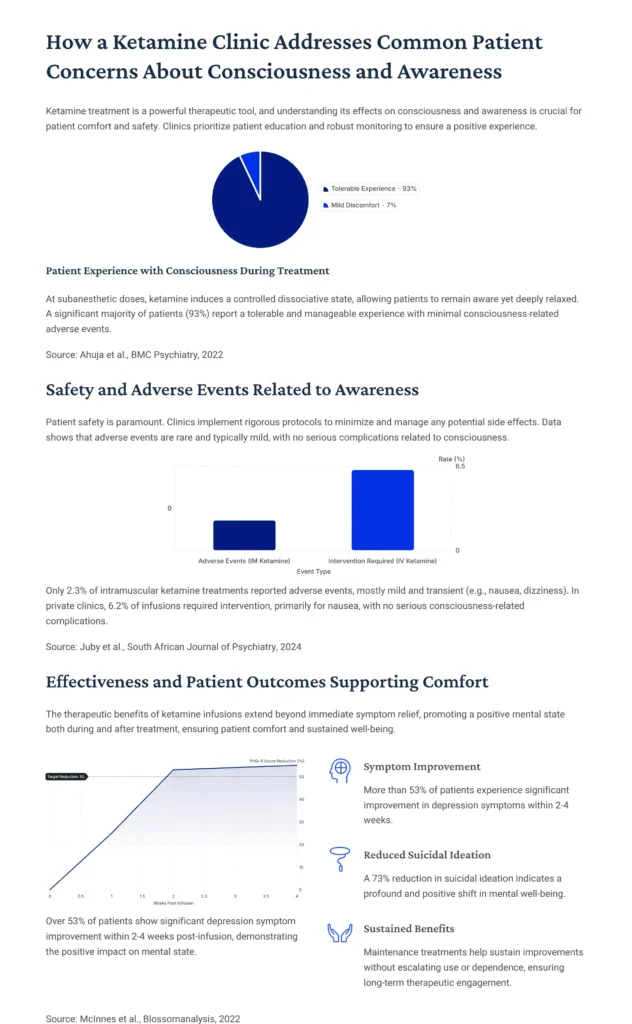
Research suggests that therapeutic ketamine does not produce long term cognitive decline when administered under medical supervision.
Some studies even suggest improved cognitive flexibility due to enhanced neuroplasticity.
This contrasts sharply with chronic recreational misuse, which involves higher doses and uncontrolled frequency.
Neuroplasticity and Brain Recovery
Ketamine stimulates pathways associated with synaptic growth. Increased connectivity in the prefrontal cortex may enhance emotional regulation.
In this sense, temporary alterations in awareness may support long term cognitive resilience.
The key lies in controlled medical use.
The Role of Environment in Awareness
Creating a calm and supportive atmosphere is not simply about relaxation. It is part of a structured clinical framework designed to maintain safety while optimizing therapeutic outcomes. From lighting and sound control to medical supervision and individualized dosing, every element is intentional. For a deeper understanding of how structured settings balance patient reassurance with medical precision, explore How a Ketamine Clinic Manages Patient Comfort Without Affecting Treatment Integrity, which explains how comfort protocols are implemented without compromising treatment effectiveness.
Sensory Inputs and Comfort
Environment matters. Lighting, sound, and seating influence perception.
A calm, quiet setting reduces sensory overload during dissociation.
This structured environment is not incidental. It is intentional.
Psychological Safety
When patients feel safe, altered states are more likely to be interpreted as therapeutic rather than threatening.
Clinics cultivate psychological safety through reassurance, consistent staffing, and respectful communication.
Communication During and After Treatment
Verbal Check Ins
Clinicians may periodically ask how the patient is feeling. This maintains connection.
Knowing that communication remains possible reassures individuals that awareness is preserved.
Post Session Integration
After the acute effects subside, patients often discuss their experience.
Verbal processing reinforces memory consolidation and helps contextualize perceptual shifts.
Integration transforms altered awareness into meaningful reflection.
Vitality Lounge Med Spa Serving the Irishtown Bend Community and Beyond in Cleveland
Vitality Lounge Med Spa is dedicated to serving the diverse needs of the local community of Cleveland, including individuals residing in neighborhood like Irishtown Bend. With its convenient location near landmarks such as the Cuyahoga River and major intersections like Carnagie Ave and Canal Rd (coordinates: Latitude: 41.4930734, Longitude: -81.694086), we offer ketamine clinic services.
Get ketamine clinic services at Irishtown Bend Now
Call Us or Contact Us (216) 202-4770
Navigate from Irishtown Bend to Vitality Lounge Med Spa Now
Concerns about consciousness and awareness during ketamine treatment are understandable. Consciousness defines how we experience reality, so any change to it feels significant.
However, therapeutic ketamine does not typically eliminate awareness. It alters perception temporarily through NMDA receptor modulation and glutamate signaling changes. Patients remain responsive. Vital signs are monitored. Dosing is controlled. The environment is structured for safety.
Clinics address fear through education, preparation, supervision, and post session integration. In discussions about Ketamine Clinic Cleveland services, emphasis is often placed on clarifying the distinction between dissociation and unconsciousness. The goal is not to remove awareness but to shift neural patterns in a reversible and medically supervised way.
Understanding the neurobiology behind these experiences reduces fear. When patients know what is happening in their brain and why, the experience becomes less mysterious and more manageable.
Altered awareness in this context is temporary, monitored, and purposeful. It is not loss of self but a carefully guided shift in perception designed to support mental health recovery.
FAQs
1. Will I be unconscious during ketamine treatment?
No. Psychiatric doses typically produce altered awareness but not full unconsciousness.
2. Can I communicate during the session?
Yes. Most patients can respond to verbal prompts and communicate basic needs.
3. Is dissociation dangerous?
In a medically supervised setting, dissociation is temporary and monitored closely.
4. Will I remember the experience?
Many patients recall at least parts of the session. Memory retention varies but is generally intact.
5. Are there long term effects on consciousness?
Current research indicates no lasting negative effects on awareness when ketamine is administered in controlled clinical environments.