

Ketamine clinics are often discussed in relation to emerging neuroscience and mental health research, yet one of the most critical aspects of these clinical environments receives far less attention. That aspect is medical evaluation. Before any neurological or psychological effects are even considered, clinics focus heavily on understanding the medical conditions that bring individuals into evaluation settings in the first place.
This article explores which medical conditions are most commonly evaluated at a ketamine clinic and why those evaluations matter. The focus remains strictly informational, grounded in clinical observation and medical screening principles rather than treatment promotion or outcomes.
Understanding the Purpose of Medical Evaluation at Ketamine Clinics
Medical evaluation at a ketamine clinic is not a formality or administrative step. It is the foundation of clinical decision making, and understanding how a ketamine clinic manages patient comfort without affecting treatment integrity provides additional insight into how clinics maintain both patient well-being and clinical accuracy
In clinical neuroscience, context matters. A person’s medical history, mental health background, and physiological status all influence how the brain responds to external substances and environments.
Why Evaluation Comes Before Any Ketamine Treatment
Before ketamine is even considered, clinicians aim to answer one fundamental question. What is the underlying condition being evaluated?
Evaluation allows clinicians to distinguish between symptoms, diagnoses, and contributing factors. It also helps identify conditions that may resemble one another but require different clinical interpretation.
Medical Evaluation vs Diagnosis
Evaluation is not the same as diagnosis. Diagnosis assigns a clinical label. Evaluation gathers data. At ketamine clinics, evaluation focuses on understanding patterns, severity, duration, and medical context rather than labeling alone.
The Role of Evidence Based Screening
Clinics rely on structured screening tools supported by clinical research. These tools reduce subjectivity and help maintain consistency across patient evaluations.
Mental Health Conditions Commonly Evaluated
Mental health conditions are among the most frequently evaluated categories in ketamine clinic environments. These evaluations focus on symptom patterns rather than assumptions.
Treatment Resistant Depression
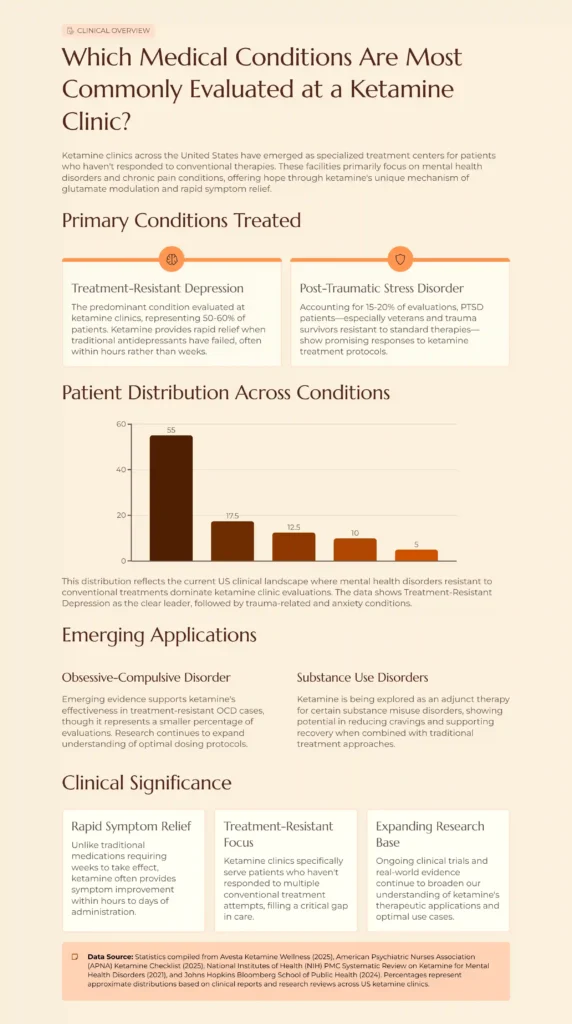
One of the most commonly evaluated conditions is treatment resistant depression. This term refers to depressive symptoms that persist despite conventional interventions.
How Resistance Is Clinically Defined
Clinically, resistance is evaluated by reviewing prior treatment history, duration of symptoms, and response patterns. Evaluation seeks to determine whether resistance reflects neurochemical factors, psychological contributors, or external stressors.
Major Depressive Disorder
Major depressive disorder is evaluated through symptom severity, duration, and functional impact. Clinics assess cognitive changes, emotional regulation, sleep patterns, and energy levels.
Anxiety Related Disorders
Anxiety exists on a spectrum, and evaluation focuses on how anxiety manifests neurologically and behaviorally.
Generalized Anxiety Disorder
This condition is evaluated through persistent worry patterns, autonomic nervous system activation, and cognitive load.
Panic Disorder
Panic disorder evaluation focuses on episodic symptoms, physiological responses, and anticipatory anxiety rather than situational fear alone.
Post Traumatic Stress Disorder
PTSD evaluation examines how past trauma affects present neurological processing.
Neurological Stress Patterns in PTSD
Clinicians observe heightened stress responses, altered emotional processing, and persistent threat perception. These patterns are evaluated without emotional framing to preserve objectivity.
Neurological and Cognitive Conditions Reviewed
Beyond mental health diagnoses, ketamine clinics also evaluate neurological and cognitive conditions that involve brain signaling and sensory processing.
Chronic Neuropathic Pain
Neuropathic pain originates from nerve dysfunction rather than tissue damage. Evaluation focuses on pain pathways, sensory abnormalities, and duration.
Migraine and Headache Disorders
Migraines involve complex neurological mechanisms. Evaluation assesses frequency, triggers, neurological symptoms, and sensory sensitivity.
Cognitive Impairment and Brain Fog
Cognitive concerns such as brain fog are evaluated by examining attention, memory, processing speed, and clarity rather than subjective frustration alone.
Pain Related Conditions Assessed in Clinical Settings
Pain related evaluations often overlap with neurological assessments due to shared signaling pathways.
Fibromyalgia
Fibromyalgia evaluation focuses on widespread pain patterns, fatigue, sleep disruption, and sensory amplification.
Complex Regional Pain Syndrome
This condition involves abnormal pain responses and nervous system dysregulation. Evaluation centers on autonomic changes, temperature differences, and sensory sensitivity.
Medical and Physiological Factors That Require Review
Medical evaluation is incomplete without assessing broader physiological health.
Cardiovascular Health
Heart rate, blood pressure, and cardiovascular stability are reviewed to understand baseline physiological conditions.
Liver and Kidney Function
These organs play a role in metabolic processing. Evaluation includes reviewing medical history and relevant test results.
Respiratory Conditions
Breathing patterns and respiratory health influence oxygenation and neurological stability, making them essential evaluation factors.
Psychological and Behavioral Health Considerations
Psychological context influences how neurological processes unfold.
Substance Use History
Clinics evaluate substance use history to understand tolerance, sensitivity, and neurological adaptation.
Dissociative Symptoms
Dissociation is evaluated carefully to distinguish between adaptive coping mechanisms and disruptive symptoms.
How Clinics Maintain Objectivity During Evaluation
Objectivity is central to evaluation integrity.
Standardized Assessment Tools
Clinics use validated questionnaires and structured interviews to reduce bias.
Avoiding Expectation Bias
Clinicians avoid framing evaluations around expected outcomes. Neutral language helps preserve accurate data collection.
Regional Evaluation Standards and Clinical Observation
Regional clinical practices contribute to broader understanding.
Observational Practices at Ketamine Clinic Cleveland Locations
Ketamine Clinic Cleveland environments often reflect standardized evaluation frameworks shaped by regulatory and clinical research standards. These settings emphasize consistency and data driven observation.
Informational Context of Vitality Lounge Med Spa
Vitality Lounge Med Spa is often referenced in observational discussions related to clinical environments and patient evaluation structures. In informational contexts, such facilities illustrate how evaluation protocols are implemented in real world clinical settings without implying outcomes or endorsements.
Ethical Principles in Medical Evaluation
Ethics guide evaluation practices. Respect for autonomy, informed understanding, and neutrality are central. Evaluation aims to inform, not persuade.
Why Evaluation Is an Ongoing Process
Evaluation does not end after the first session. Neurological and psychological conditions evolve over time. Ongoing evaluation helps clinicians interpret changes accurately without attributing them prematurely to specific factors.
Vitality Lounge Med Spa Serving the The Flats Community and Beyond in Cleveland
Vitality Lounge Med Spa is dedicated to serving the diverse needs of the local community of Cleveland, including individuals residing in neighborhood like The Flats. With its convenient location near landmarks such as the Old River and major intersections like Division Ave and W 45th St (coordinates: Latitude: 41.4930734, Longitude: -81.718117), we offer Ketamine Clinic services.
Get Ketamine Clinic services at The Flats Now
Call Us or Contact Us (216) 202-4770
Navigate from The Flats to Vitality Lounge Med Spa Now
Medical evaluation at a ketamine clinic serves as the cornerstone of clinical integrity. By carefully assessing mental health conditions, neurological disorders, pain related syndromes, and physiological factors, clinics create a foundation for accurate observation and responsible care. Understanding which conditions are most commonly evaluated helps clarify the purpose of these clinical environments and highlights the importance of evidence based screening in neurological care.
Frequently Asked Questions
1. Are ketamine clinics focused only on mental health evaluation?
No. While mental health conditions are commonly evaluated, clinics also assess neurological, pain related, and physiological conditions.
2. Does evaluation mean treatment will automatically follow?
No. Evaluation is an information gathering process and does not imply treatment decisions.
3. Why is treatment resistant depression evaluated separately from depression?
Resistance involves different clinical considerations related to treatment history and neurological response patterns.
4. Are physical health conditions relevant in neurological evaluation?
Yes. Cardiovascular, respiratory, liver, and kidney health all influence neurological stability.
5. Why is objectivity emphasized so strongly during evaluation?
Objectivity ensures that observations reflect medical reality rather than expectations or assumptions.